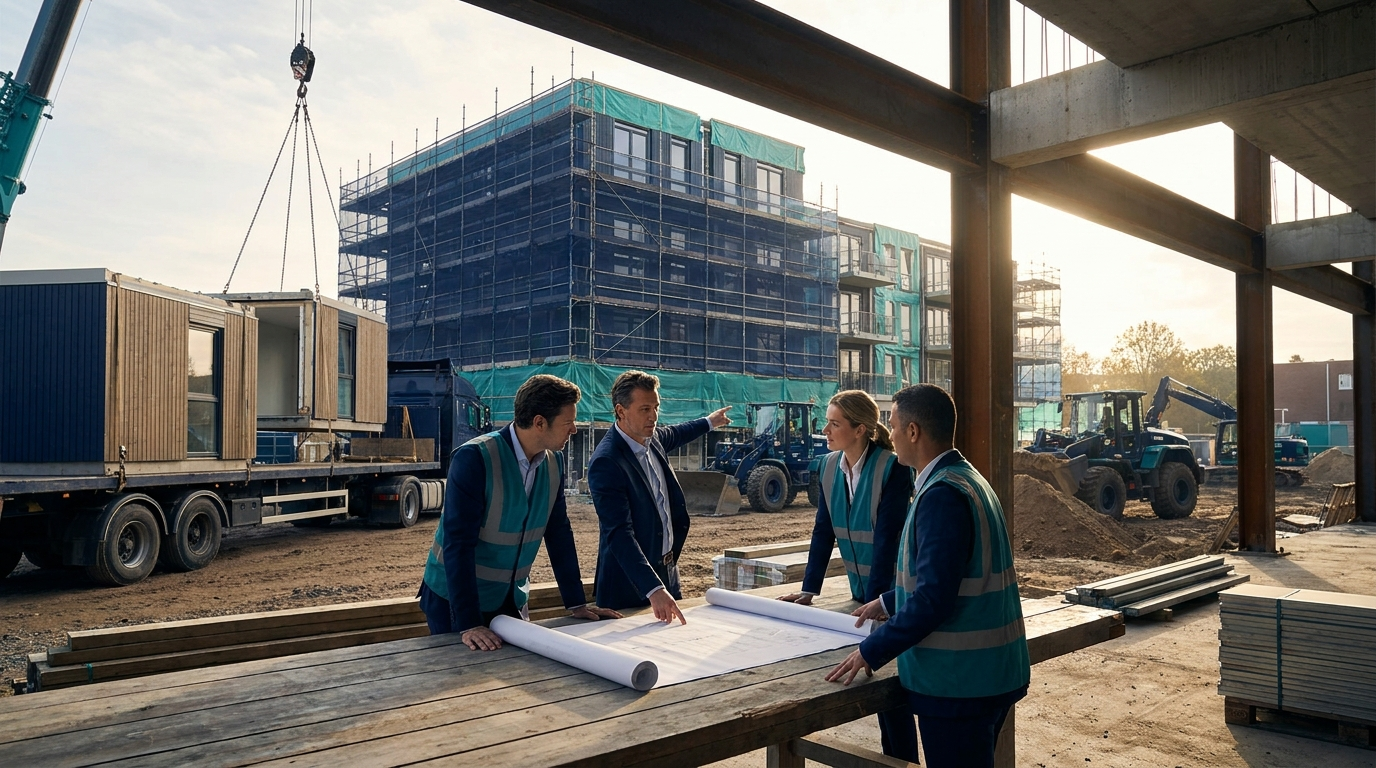
Friday we told you the government was now sitting at the table on the affordable component of Wellington Towers. Today, the number. Up to 500 permanently affordable homes, and the sliding scale that gets us there: 30%, 40%, or 50% of the total units across both towers held as deeply permanent affordable.
PV, Mit & Jeff
Three things have to be true. All three are moving this week. Here is where each one stands.
Friday PV and Jeff sat down for the weekly livestream and walked through what actually happened in London the week before. If you missed it, the raw version is below and it is worth 30 minutes. It is the source tape for everything in today's note.
The headline coming out of those meetings was a number. Up to 500 permanently affordable homes across both Wellington towers on the London BRT corridor. Not a covenant that expires. Not a subsidy tied to a five year window. Permanent affordable rent, held for the life of the buildings, on units the private market cannot deliver at the price a working Londoner can actually pay.
The exact number of doors is not fixed. It moves with one variable: how much capital the government puts on the table. The more they put in, the deeper the share of the two towers we can hold as permanently affordable. Three tiers are in play right now. 30%, 40%, or 50% of the total units delivered as deeply permanent affordable. At the top of that scale, that is up to 500 doors across the two towers. Today, the three things that have to be true for that to happen, and where each one stands.
PV and Jeff walk through the ministry meeting, the London waitlist behind the demand, and what the September council file actually decides.
The reason last week's ministry meeting mattered is that three separate pools of public capital are looking at the same project at the same time. Federal, through Build Canada Homes. Provincial, on the affordable housing side tied to the transit oriented density the Wellington BRT corridor was funded to enable. Municipal, through the City of London's own affordable housing tools.
The mechanism is simple. The more capital the three levels of government put into Wellington, the deeper the share of the total units across both towers that we can hold as permanently affordable. Three tiers are in play right now, all measured as a percentage of the total unit count across the two towers.
Every dollar of public capital that lands in the stack replaces private capital that would otherwise need to be raised, at no cost to the return math for accredited LPs already in Tranche 1. More government in, more affordable doors out. That is the negotiation this week.
London's community housing waitlist sits at more than 7,000 households. Working Londoners, families, seniors, people on ODSP, people in transitional care. All of them qualified. All of them waiting years for a unit at a rent they can actually pay.
Every affordable door Wellington Towers delivers at $980 to $1,100 per month is a door that comes directly off that list. Five hundred permanently affordable homes on the BRT corridor is roughly seven percent of the entire London waitlist, cleared out of two towers on one site.
This week we are formalizing conversations with several non profit and government partners about master lease arrangements for blocks of those affordable units. A master lease means the counterparty on the other side of that lease is a stable institution, not an individual tenant. From a private investor's perspective, that is one of the lowest risk streams of rental income you can hold in a building. The demand side of the pro forma is not a projection. It is a waitlist with names on it.
The Wellington Towers application heads to London city council at the end of September. Between now and then, ten weeks of engagement with community stakeholders across the city on the details of the site, the affordability commitment, and the transit case.
A yes vote from council is a yes on three things at once. Affordable housing in a housing shortage. Transit ridership on the corridor the province just spent roughly half a billion dollars building. Two towers of infill density on one parcel instead of scattered smaller projects across the city. That is the case we are making at every table between now and September, and it is the last hinge between 500 permanently affordable doors on paper and 500 permanently affordable doors in the ground.
If you are an FCPRET holder, the read through is simple. Every Foundation Capital vehicle sits on the same operating platform. The same team sitting across from ministry officials on the development side is running the buildings your monthly distribution comes out of. The credibility we are building at Queen's Park is credibility that follows every future acquisition on the FCPRET side too.
If you are an accredited investor watching Foundation development capital, the frame is Development Fund III. Tranche 1 of Fund II is closed. Fund III is the next opportunity in the pipeline, and its shape is being drawn by exactly the conversations behind those 500 doors. If you want to be at the table before that round takes shape, this is the week to signal it.
$10K Minimum · RRSP / TFSA / RESP / LIRA Eligible
Targeted: 15% Annualized (7% cash monthly + 8% appreciation)
Mid market core workforce housing across Southern Ontario. Open to new subscribers.
432 Units · 25 Storey Purpose Built Rental · London, ON
Tranche 1 closed. Accredited investors interested in Development Fund III should signal now.
Have a good week,
PV, Mit & Jeff
P.S. If you have not seen Friday's livestream yet, it is the raw version of everything in today's note. Reply Doors if you are accredited and want to be looped in as Development Fund III takes shape.