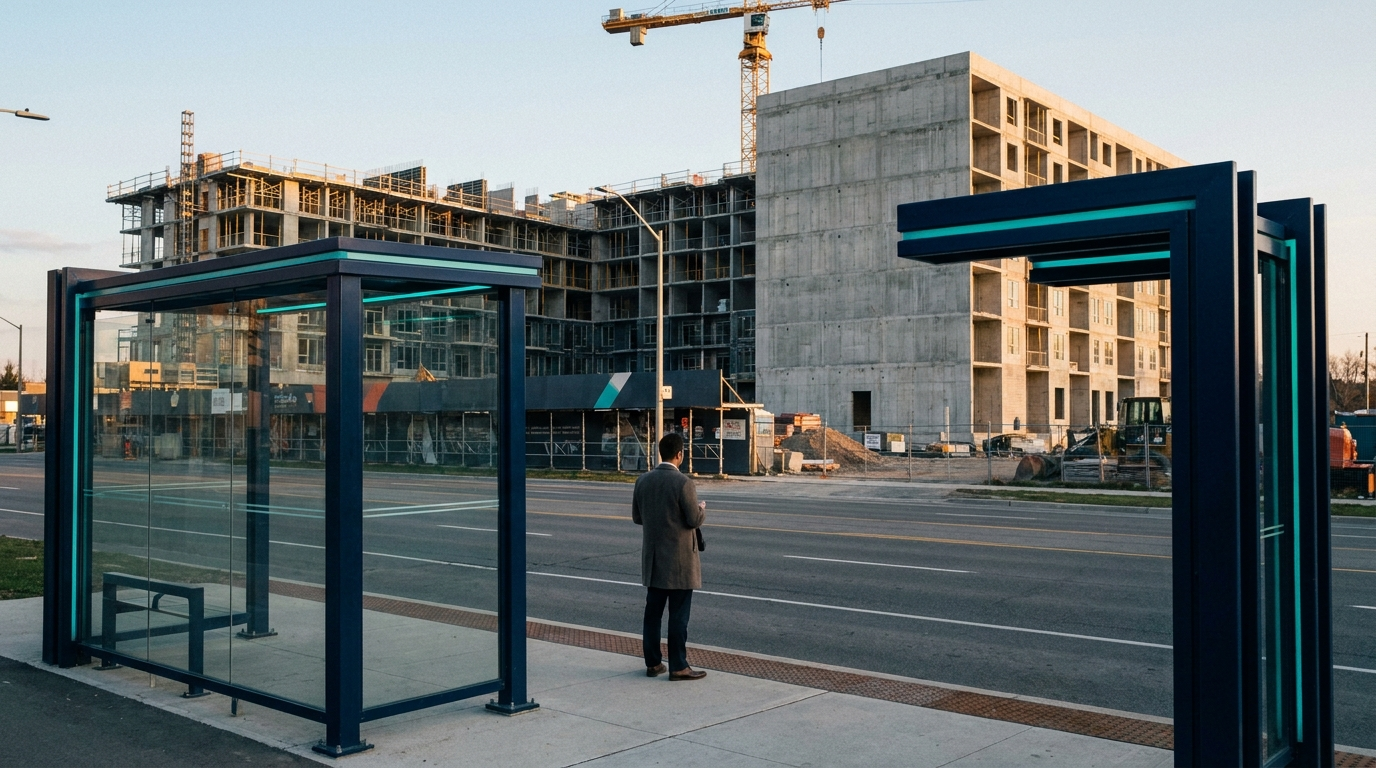
We keep saying the province spent half a billion dollars on the London BRT. Today, what they actually bought, and the piece almost nobody talks about: every BRT project is a housing bet in disguise. Wellington Towers is the housing on the other side of that bet.
PV, Mit & Jeff
Every BRT project is a housing bet in disguise. If the density does not show up on the corridor, the ridership does not show up on the bus. Today, what that means for Wellington Towers, and for every private investor sitting adjacent to this file.
Four letters in a row we have used the same phrase. Roughly half a billion dollars into the London Bus Rapid Transit corridor. Today's letter is the explainer. What that money actually bought, why the corridor exists at all, and the part almost nobody outside city hall talks about: every BRT project is a housing bet in disguise.
If you understand this, you understand why the province has skin in the game on Wellington Towers. If you do not, most of what we have been writing for the last week reads as coincidence. It is not.
London's Bus Rapid Transit program is called Shift. It is not a single line. It is three connected corridors funded jointly by the federal government, the Province of Ontario, and the City of London, with a combined public capital commitment in the range of half a billion dollars.
This is not a paint job on a bus route. It is dedicated pavement, dedicated signals, dedicated stations. A public commitment on the scale of a small transit line, delivered as a bus service.
A regular city bus sits in traffic. A BRT bus does not. The lanes are its own. The intersections yield to it through signal priority. The stations are permanent structures with off board fare collection so boarding happens in seconds, not minutes. In practice, a well designed BRT delivers something close to light rail level of service on the operating cost of a bus network.
The reason cities build BRT is that the return on the capital only works if people actually ride it. That means the corridor needs density along its length. Empty parking lots and single detached homes do not fill a BRT. Purpose built rental at scale does.
This is why every BRT project the province has ever funded comes with a matching policy conversation about how the land beside the corridor gets used. That policy conversation is called transit oriented development. It is not a courtesy. It is the ROI thesis.
Every dollar of BRT capital is implicitly a bet that the housing on the corridor will change over the next decade. More units per hectare. More rental. Less parking, because the whole point of putting the bus in a dedicated lane was to give riders a real alternative to a car.
If that housing does not get built, the ROI does not land. The province ends up owning six kilometres of transit only pavement moving a bus that is only two thirds full. That is not the outcome anyone in the ministry wants. It is the outcome they are actively spending political capital to avoid.
Which is why, when a private operator shows up with a shovel ready two tower purpose built rental project on the corridor, permitted at high density, with minimal parking, and with a proposal where anywhere between 10% and 50% of the units are held as deeply permanent affordable at rents between roughly $980 and $1,500 per month, the province does not treat that operator as a supplicant. They treat them as a partner. Because the operator is delivering exactly the outcome the BRT capital was spent to enable.
The site is on Wellington Road, directly on the Wellington Gateway corridor. Not adjacent. Not near. Directly on the lane the province has just widened, restriped, and reserved permanently for the buses that connect downtown London to the airport industrial park at Highway 401.
A tenant living at Wellington Towers, on an affordable unit priced between roughly $980 and $1,500 per month, does not need a car to get to work. The BRT takes them south to the industrial park in twelve minutes and north to downtown in eight. That is the trade being offered to the working Londoner who has been priced out of the rest of the private rental market. Housing, transit, and income within reach of each other. That combination has not been available to that tenant in this city for the last thirty years.
Some of the loudest online pushback on Wellington Towers is about parking. Not enough spaces. Where will they all park. And the answer is that the site is not designed to be parked. It is designed to be ridden to. That is the whole point of building on a BRT corridor. If Wellington Towers had 1.5 parking spaces per unit, it would not be a transit oriented development at all. It would be a highway development with a bus stop out front, and the province would not fund the affordable stack.
The city's own planning policy on the Wellington Gateway explicitly permits minimum parking on the corridor by design. That is not a loophole we are exploiting. That is the province's stated land use vision on a corridor they just funded.
Two things flow from this. First, the reason the government keeps returning our calls on the Wellington file is not charity. It is because our project completes the ROI on capital they have already committed. That is the strongest possible negotiating position a private operator can be in with a level of government.
Second, this is not a one time trade. Every mid market city in Ontario is either building a BRT, planning a BRT, or being funded to plan one. Kitchener has ION. Hamilton is finalizing its LRT. Brampton is building the Queen Street BRT. Every one of those corridors will need the same purpose built rental with a below market affordable stack sitting on it. The Wellington template travels. That is what Development Fund III is being drawn around, and it is the moat we are building for every Foundation Capital vehicle that follows.
PV and Jeff on the corridor, the ministry meeting, and what the September council file actually decides.
$10K Minimum · RRSP / TFSA / RESP / LIRA Eligible
Targeted: 15% Annualized (7% cash monthly + 8% appreciation)
Mid market core workforce housing across Southern Ontario. Open to new subscribers.
Roughly 1,000 Units Across Two Towers · London, ON, On The Wellington Gateway BRT
Tranche 1 closed. Accredited investors interested in Development Fund III should signal now.
Talk soon,
PV, Mit & Jeff
P.S. Kitchener, Hamilton, and Brampton are all running the same play. Reply Corridor if you are accredited and want the read through on which Ontario mid market cities Development Fund III is being drawn around.