That is the number of households on London's community housing waitlist. CBC ran a piece this week on our plan to move as many of them as possible into permanent, affordable homes. Today, the full read on what we filed, who it is for, and why the August 31 window matters.
PV, Mit & Jeff
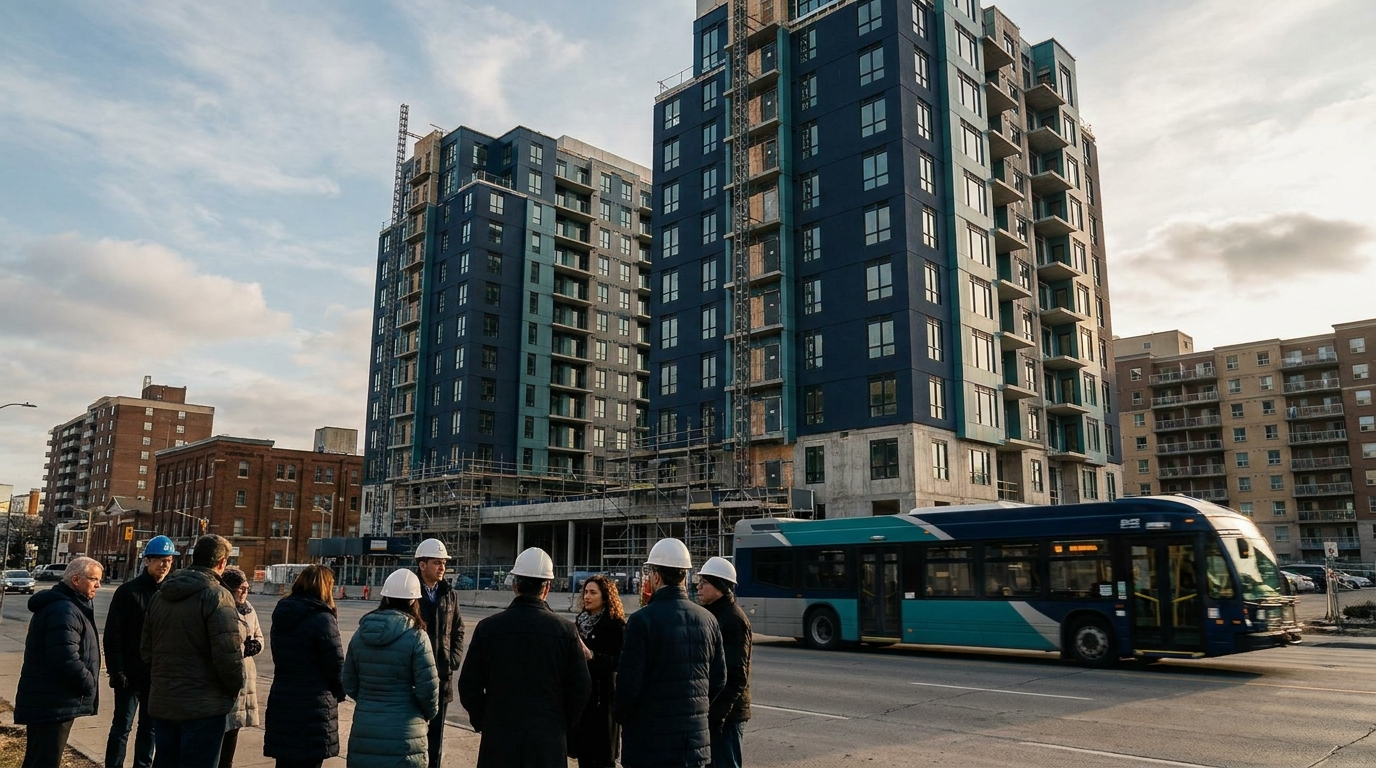
1,004 apartments. Two towers. On the Wellington Bus Rapid Transit corridor. Priced for the Londoners the market has stopped serving. Public comments open until August 31.
Earlier this week, CBC News London ran a piece on our two tower proposal on the Wellington corridor. The headline led with the number: more than one thousand apartments filed with the City of London. Today's letter is the full context on what we filed, who it is designed to serve, and how our capital stack lets us push rents further below market than the private market can normally reach.
If you have not read the CBC piece yet, it is the plain language read on what we filed. Ten minute read.
CBC News London walks through what we filed, who it is for, and where the file goes next. Ten minute read.
London's community housing waitlist has grown to more than 7,500 households. A household is not one person. It is a family. A parent and their kids. A senior and their caregiver. A couple. The real number of Londoners behind that 7,500 is meaningfully higher. Working families, seniors on fixed income, people on ODSP, single adults on the lowest end of the wage curve, all of them waiting years for a unit they can actually pay for.
The private market cannot serve them. Not at $2,000 for a one bedroom. Not at $2,500 for a two bedroom. The math simply does not work for a working Londoner on $22 an hour. That is the demand gap Foundation Capital designed the Wellington towers to fill.
Foundation Development Fund has filed two applications on London's Wellington Gateway. 26 storeys at 60-68 High Street. 28 storeys at 57-75 Wellington Road. Roughly 1,004 apartments, priced from $980 per month, on the Bus Rapid Transit corridor the province is investing roughly half a billion dollars to build.
Every unit is designed for a Londoner the private market has stopped serving. The nurse working nights at Victoria Hospital. The warehouse worker at the airport industrial park. The senior on a fixed income who watched their rent double in a decade. The single mom on $22 an hour paying two thirds of her paycheque to her landlord. That is the entire building. Workforce and affordable housing at 1,004 doors, at a scale London has not seen delivered by a private operator in a generation.
Inside that mix, we are structuring a share of units as deeply affordable for the households that need it most. Seniors on fixed income. Households on ODSP. People in transitional care. Working Londoners at the lowest end of the wage curve.
Ontario's own definition of "affordable" is 100% of average market rent. That is the standard the province uses to count how much affordable housing gets built each year. It is also, in practice, just market rent.
Our proposal goes deeper than that. With federal, provincial, and municipal grants and incentives coming into the capital stack, we are pushing the deeply affordable share even lower than $980 per month. And on the share of the building held permanently affordable, we can scale from a 10% floor to as high as 50% depending on how the government comes in.
Every one of those doors is a household that comes directly off the 7,500 household waitlist. The more capital the three levels of government put behind this project, the more of that waitlist we take with us.
Ontario is currently in the middle of a roughly half a billion dollar investment in the London Bus Rapid Transit corridor. The province did not make that investment as a public works project on its own. They made it because they need the density and the ridership on that corridor to justify the public capital they have committed. That housing has to get built by someone. If it does not, the province owns six kilometres of transit only pavement and a bus service that is only two thirds full.
In every conversation we have had with government officials this year, the message coming back has been consistent. The province would be very supportive of this project. Not because of us. Because Wellington Towers is exactly the kind of transit oriented affordable housing that lets the BRT investment deliver its intended ROI. Riders on the bus. Households in the units. Waitlist shrinking. Corridor densifying. That is the outcome the ministry has been working toward, and they have said as much to us directly.
When a private operator shows up on a transit corridor the province just funded, with roughly 1,004 units of purpose built rental designed for the working Londoner, and asks the government to sit in the equity stack on the affordable component, that is a partnership the province has every reason to lean into.
We are designing the building as a mixed community by design, not by accident. Floors for seniors on a fixed income. Floors for working single adults. Floors for students. Floors for households on ODSP and in transitional care. Different tenants, different rents, different parts of the building. All of them Londoners.
The design lets us pair partnerships with the not for profit organizations already doing the operating work in each of those groups. Seniors housing partners on the seniors floors. Supportive care partners on the transitional floors. That combination, private operating expertise plus not for profit and government partnership, is what lets the rent bands actually work and hold over time.
The Wellington applications are open for public comment with City of London Planning until August 31. That window is when councillors, ministry staff, and community stakeholders read the pulse of the city on the file. Comments in support of building affordable housing at scale on a transit corridor matter.
If you agree that London's housing crisis is going to be solved by projects like this one, that is the place to say it. Comments can be submitted directly through the City of London Planning department.
On the FCPRET side, the Wellington affordable stack unlocks something meaningful for the Apartment Building REIT that has not been possible until now. When the Wellington units come online, we can offer existing lower paying tenants in our FCPRET buildings the option to move into a purpose built affordable unit at Wellington. That is a better home for the tenant, on a transit corridor, in a purpose built building designed for them. And on our side, it opens up FCPRET units we can then renovate, re densify, and reposition, exactly the compounding engine we wrote about on Thursday.
In other words, the two funds do not just share an operating team. They feed each other. Wellington gives us a landing spot for tenants who deserve better than the older 1970s stock they are currently in. FCPRET gives us the older stock we can then improve, once those tenants have moved on to a better home on their own timing. The Apartment Building REIT gets stronger every time a Wellington affordable unit comes online.
On the development side, the shape of Foundation Development Fund III is being drawn by exactly the conversations sitting behind the CBC piece. Tranche 1 of Fund II is closed. Fund III is next. If you are accredited and want to be at the table before that round takes shape, this is the week to signal it.
PV and Jeff on the ministry meeting, the London waitlist behind the demand, and what the September council file actually decides.
$10K Minimum · RRSP / TFSA / RESP / LIRA Eligible
Targeted: 15% Annualized (7% cash monthly + 8% appreciation)
Our Apartment Building REIT across Southern Ontario, quietly re densifying floor by floor as units turn over voluntarily. Open to new subscribers.
Roughly 1,004 Units Across Two Towers · London, ON, On The Wellington Gateway BRT
Tranche 1 closed. Accredited investors interested in Development Fund III should signal now.
Have a great weekend,
PV, Mit & Jeff
P.S. If you support the Wellington application, London Planning is accepting public comments until August 31. Every voice from the community that says the housing needs to get built matters at the council table. If you are accredited and want to talk about Development Fund III, reply Waitlist.