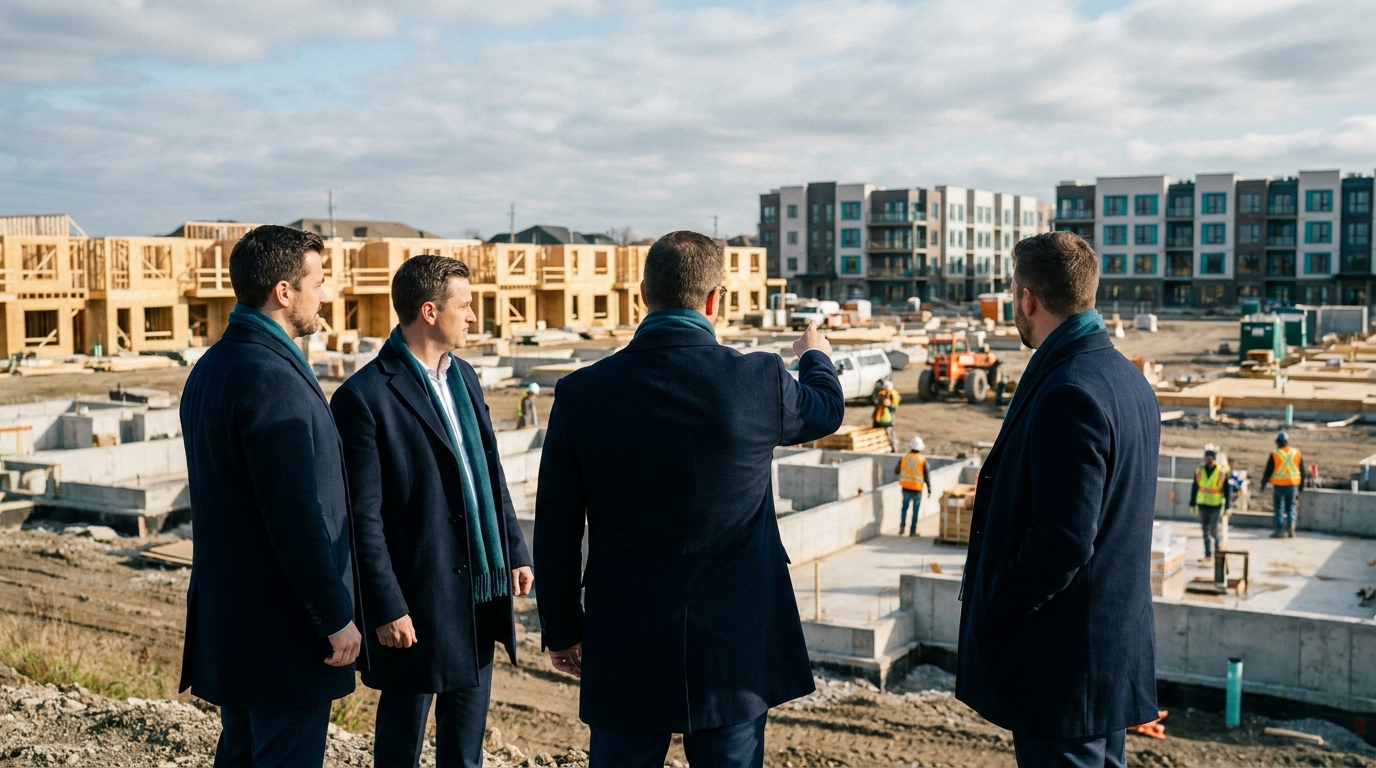
That is the size of the bet Berkshire Hathaway just made on housing. Berkshire does not move at this scale unless it sees something durable for the next decade. Today, what that signal tells us about the next five years in Canadian apartments.
PV, Mit & Jeff
The most disciplined capital allocator in the world rarely moves at this scale. When it does, the question is not whether to pay attention. The question is what it sees that the market does not.
This morning, Berkshire Hathaway announced the acquisition of homebuilder Taylor Morrison in an all cash deal valued at $6.8 billion, one of the largest single bets on residential real estate the firm has ever made. It is also the first major strategic deal under Greg Abel, Warren Buffett's successor, who took over as CEO at the start of 2026. When Berkshire deploys this kind of capital, it is not chasing a trade. It is buying a structural mispricing it expects to be true for the next decade.
The question for any investor reading this is the same one we have been asking ourselves all year. What does the most patient capital in the world see in housing that the daily market noise keeps missing?
Berkshire does not chase cycles. It buys structural realities. The reason a $6.8B housing bet lands now is that the supply shortage in North America is not a six month phenomenon. It is a multi decade undersupply tied to land use policy, construction labour shortages, immigration patterns, and rate sensitive ownership math. When the most disciplined capital allocator in the world places its biggest housing bet ever, it is telling you the shortage is the regime, not the noise.
A $6.8B allocation only works if housing cash flow is treated like a long duration coupon. Berkshire does not allocate that kind of capital to assets that get repriced every quarter. It allocates to assets that throw off predictable cash flow for thirty years. The institutional bid for residential cash flow as a long duration income stream is now firmly in place, and it is exactly the same bid that exits stabilized purpose built rental at sub 4% cap rates.
The US is short roughly 3 to 4 million homes. Canada is short 3.5 million by CMHC's own forecast, on a population one tenth the size. Per capita, our housing shortage is materially worse than the one Berkshire just bet $6.8B on. Add government incentives Berkshire does not get (CMHC MLI Select at 95% loan to cost, municipal CIP grants, DC exemptions) and the Canadian apartment trade has a sharper edge than the US single family trade it is buying.
We are doing in Canadian purpose built rental what Berkshire is signalling in US housing. We just happen to be doing it earlier in the chain, at developer cost basis, with CMHC financing locked, and in a country where the shortage is worse and the policy stack is more favourable.
Berkshire is buying the asset. We are building it. The next time a Berkshire style institutional buyer writes a Canadian cheque, they are buying buildings like Wellington Towers from sponsors like us.
Meanwhile, if you want to add Canadian apartment exposure to your portfolio while the asset class is still mispriced relative to where Berkshire just put $6.8B, the door is wide open. FCPRET starts at $10,000 and the Canada Day 2% bonus runs for another 30 days.
$10K Minimum · RRSP / TFSA / RESP / LIRA Eligible
Targeted: 15% Annualized (7% cash monthly + 8% appreciation)
Subscribe by Canada Day for +2% bonus units (30 days left)
432 Units · 25 Storey Purpose Built Rental · London, ON
$100K Min · Cash Only · Accredited / Existing FC Investors
Tranche 1 Extension: 24% Net Annualized Targeted Return
Have a strong week,
PV, Mit & Jeff
P.S. The single most useful thing you can do with the news of a $6.8B housing bet is treat it as confirmation of a thesis you can act on. We have been building toward this exact moment for years. The FCPRET 2% Canada Day bonus is still open for the next 30 days. Reply Berkshire if you want one of us to walk you through the parallel between what they just bought and what we are building.