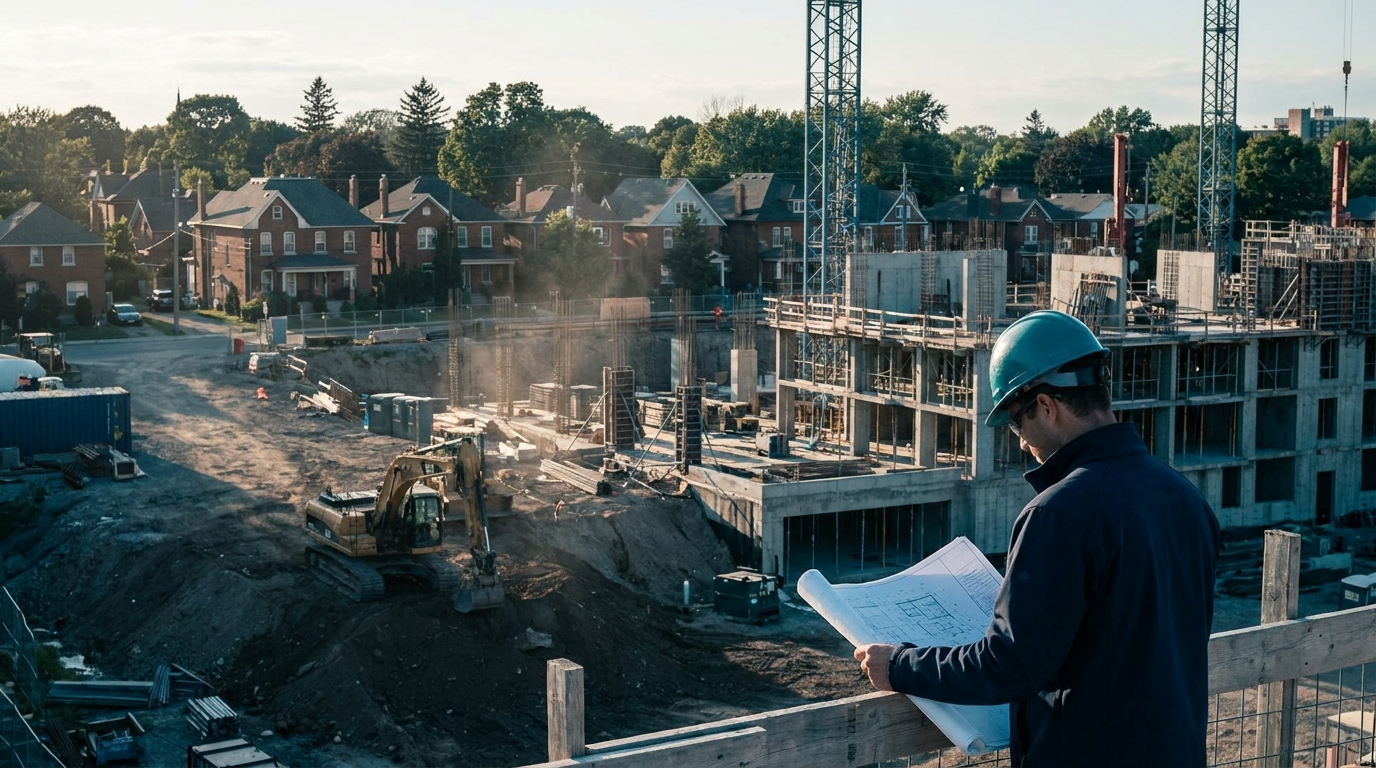
That is how many rental units are under construction across Canada right now. The biggest number on record. The headlines call it a fix. The math says otherwise.
PV, Mit & Jeff
The biggest rental construction pipeline in Canadian history sounds like the supply problem is over. The arithmetic underneath says it has barely started. Today, the numbers that nobody is putting together in one place.
Canada now has more than 180,000 rental units under construction, the highest figure in the country's history. For the first time on record, rental projects outnumber condo and detached house starts combined. That is real, that is structural, and it is being celebrated as proof that the housing supply problem is finally being solved.
The headline reads like good news. The math is more interesting than that. 180,000 units is a record, and at the same time it is nowhere near enough to close the shortage in any reasonable time frame. The point of this letter is to show you the numbers nobody is putting together in one place, and explain why the supply story is structurally bullish for existing apartment owners regardless of how many shovels are in the ground today.
Start with the four numbers that frame the whole conversation. Each one is from a CMHC or Statistics Canada release. None of them are in dispute.
An apartment building takes three to four years to build. The 180,000 units under construction today are spread across that timeline. The actual annual completion rate is somewhere between 45,000 and 60,000 new rental units per year, which is high by historical standards and still well below what is needed to keep up with new household formation alone, never mind the existing shortage.
Even with slowed immigration, Canada is forming somewhere between 250,000 and 400,000 new households per year. Every one of those households needs somewhere to live. The math of 50,000 new rental units a year against 300,000 new households a year is not a math that closes a shortage. It is a math that grows one, slowly, year after year.
Mit and Jeff sit down with Canadian real estate investors on what is actually breaking the market right now, and how disciplined operators are positioning around it.
The 180,000 figure reflects projects launched mostly in 2022 and 2023, when financing was looser, costs were lower, and CMHC MLI Select had not been re-priced. Residential construction has contracted for three straight months on the most recent data. The pipeline being delivered over the next 36 months is the high water mark, not a forecast of what is coming after it. CMHC is raising multi-unit mortgage premiums on June 19. Every new project that gets greenlit after that date underwrites to a tighter, more expensive cost structure.
If completions hold at the record pace of 60,000 rental units per year for the entire next decade (an optimistic assumption given the construction contraction and CMHC tightening) and household formation runs at the mid case of 325,000 per year:
The supply gap creates two distinct sources of demand at the same time, and both of them flow to the operator who can deliver mid-market rent in a Southern Ontario city.
First, demand for the actual rental units. The household that cannot afford a $3,000 downtown Toronto rent is not going to disappear. They go to London, Ingersoll, Chatham, the cities where a one bedroom rents for closer to $1,800. The supply gap pushes household formation out into exactly the markets we operate in. That is rent demand with a structural tailwind for as long as the gap stays open.
Second, demand for the buildings themselves. Institutional buyers (pension funds, life cos, private equity rental platforms) need to deploy capital into purpose built rental and there is not enough product to absorb the money rotating into the asset class. A stabilized building with locked CMHC financing and a real rent roll is what they buy. That is exit demand with a structural tailwind for as long as the gap stays open.
FCPRET owns existing multi-family residential apartments across Southern Ontario at the mid-market rent band that captures the household demand the supply gap pushes outward. CMHC backed long term debt is locked. Monthly distributions are paid from rent that has nowhere to go but up while the gap stays open.
Wellington Towers is our 432 unit contribution. A 25 storey purpose built rental tower in London with CMHC financing locked under pre June 19 terms. The rent stack is deliberately priced inside the market: 90% of units at roughly $1,500 per door and 10% at $980 as deeply affordable units. With the comparable London one bedroom renting at $1,800, the entire building is positioned below market on purpose. That is what makes the lease-up fast and the exit clean. The strategy is build, lease up to stabilization, exit to the institutional buyer who needs the product more than we need to hold it. The Tranche 1 extension targets 24% net annualized for accredited investors helping to fund the build.
The Canada Day 2% bonus on FCPRET runs for another 22 days. RRSP, TFSA, RESP, LIRA, and cash accounts all eligible. Starts at $10,000.
432 Units · 25 Storey Purpose Built Rental · London, ON
$100K Min · Cash Only · Accredited / Existing FC Investors
Tranche 1 Extension: 24% Net Annualized Targeted Return
$10K Minimum · RRSP / TFSA / RESP / LIRA Eligible
Targeted: 15% Annualized (7% cash monthly + 8% appreciation)
Subscribe by Canada Day for +2% bonus units (22 days left)
Talk soon,
PV, Mit & Jeff
P.S. The supply gap is the single longest duration thesis available to a Canadian investor right now. Reply Supply if you want one of us to walk you through where FC sits inside that math and how a position compounds over the decade ahead. FCPRET 2% Canada Day bonus is open for 22 more days.