Our targeted rent versus where comparable London purpose built rental lands by 2030 at even conservative growth. We are going precast to compress the build, contain cost volatility, and come online into a rent environment materially higher than the one we underwrote.
PV, Mit & Jeff
Trades are available. Subs are returning calls. And our exit does not depend on selling a single condo unit. Here is why building in this market is the safest part of the trade.
Most of Toronto's planned condo pre sales just collapsed. CMHC is forecasting new starts to keep falling through 2028. Tariffs are stacking on top of steel, aluminum, and finished materials. Almost every developer on this side of the table is paused, restructured, or quietly looking for an exit.
We are advancing 432 purpose built rental units in London. Site assembled. Precast supplier lined up. Construction starts 2027/2028, project complete by 2030.
That is not bad timing. That is the entire trade. The window everyone else is avoiding is the one we built for
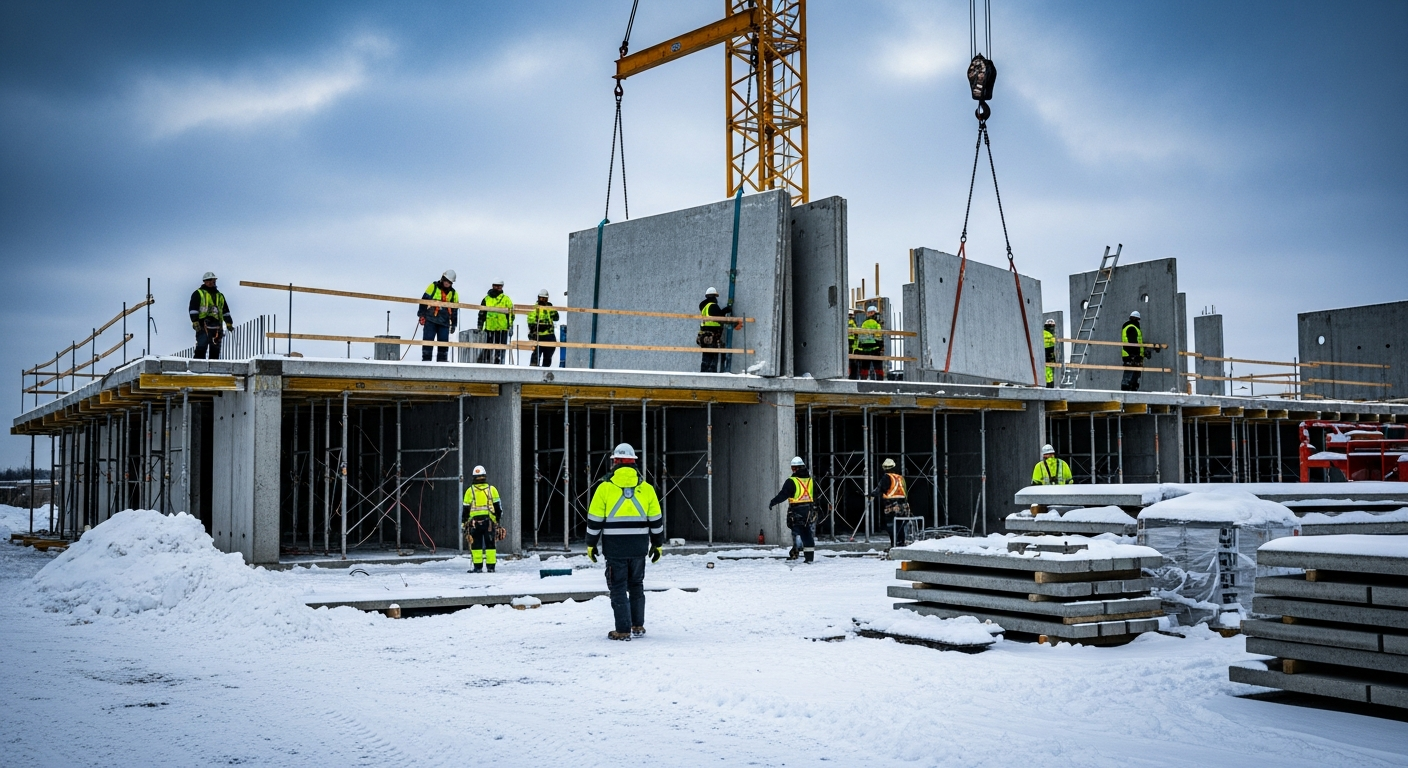
Tariffs are real. Steel and aluminum costs are climbing. Hard costs on cast in place towers across Canada are up 8 to 12% in the last 18 months and still moving. So we are not building cast in place. Wellington Towers is going up as a precast concrete structure, and that decision is the single biggest risk reducer in the project.
Factory pricing, not site pricing. Structural components are produced in a controlled facility on a contracted schedule, not exposed to daily commodity swings or trade availability the way site poured concrete is.
Build timeline compressed 30 to 40%. Less time under construction means less exposure to inflation, fewer carry costs on financing, and an earlier rent roll.
Fewer trades on site, lower labour risk. Skilled trades remain the tightest constraint in Canadian construction. Precast moves the labour into a factory where it is available, repeatable, and not weather dependent.
Weather neutral. Ontario winters routinely kill three to four months of cast in place productivity. Precast does not stop in February.
Every one of those levers cuts our exposure to the exact environment that is breaking other developers. The build method itself is the hedge.
London is in a structural workforce housing shortage. Nurses, tradespeople, manufacturing staff, young professionals. The people who keep a city running. The supply being built for them keeps shrinking.
We are coming online at $1,500 a door in a market where comparable purpose built rental is already asking $1,800. We break ground in 2027/2028 and stabilize by 2030. From today's $1,800, four years of compounded growth at a conservative 4% clears $2,100 by the time we stabilize. At London's recent trend closer to 6%, it is $2,275. At 7%, it is over $2,360.
We are not just under market today. We are under market against a curve moving away from us. The spread does not narrow. It widens every year until lease up. The lease up is not a risk. It is a queue.
Condo developers need 432 individual buyers to show up with mortgage approvals and down payments to clear the project. If retail is soft, they are stuck. We need one buyer to acquire a stabilized, cash flowing, purpose built rental building. And here is the part that makes this exit different from almost every other real estate exit in the country.
Our buyer can acquire Wellington Towers using CMHC insured financing at 5% down. The same MLI Select program that supports building purpose built rental at low equity also allows a qualified acquirer to buy the stabilized asset at the same leverage. That single fact transforms who the buyer pool actually is.
It is not just pension funds writing $200M all cash cheques. It is:
Mid sized Canadian REITs
Private family offices that own 500 to 5,000 units
Institutional capital from the US and overseas with Canadian PBR mandates
High net worth private buyers consolidating multi family portfolios
Every one of those buyers underwrites at sub 4% cap rates because their cost of capital is 3% and CMHC is taking the mortgage risk off the table. We build at a 5.5% cap. They buy at a 4% cap. That spread between what we build at and what they acquire at, multiplied by the leverage their financing allows, is the return. It does not depend on retail sentiment or condo psychology. It depends on a building with a rent roll, an income statement, and CMHC eligibility. We are building all three.
432 Units · 25 Storey Purpose Built Rental · London, ON
$100K Minimum · Cash Only · Accredited / Existing FC Investors
Targeted Return: 20% to 24% Annualized
The real money in real estate has never been made by people who waited for conditions to feel safe. It has been made by the people who wrote the cheque when everyone else was sitting on their hands.
The investors who bought Toronto multi family in 1991 during the recession. The ones who bought US apartments in 2010 when nothing was clearing. The ones who put capital into Canadian development in 2014 when oil crashed and confidence evaporated. They were called early. Then they were called lucky. They were neither. They acted while everyone else was waiting for permission.
2026 is one of those windows. Rates are elevated. Headlines are negative. Construction starts are falling. Developers are paused. Capital is scared. That is exactly the environment that has produced every great real estate fortune of the last forty years.
Wellington Towers is not waiting for permission. The site is locked. The precast supplier is lined up. The capital stack is being built right now. The only question is whether you are on the cap table when this stabilizes in 2030, or whether you are reading the exit announcement in this newsletter.
Stabilized Multi Family Buildings · Southwestern Ontario
$10K Minimum · RRSP / TFSA / RESP / LIRA Eligible
Targeted Return: 15% Annualized (7% cash + 8% appreciation)
"We looked at REITs, GICs, and even buying a rental property ourselves. None of them did what Foundation Capital does. The team picks up the phone, the distributions show up on time, and the math actually works."
CMHC's next housing starts report drops later this month. Early signals from London brokers suggest the gap between our $1,500 build and the $1,800 market is widening, not narrowing. Every new data point that comes in pushes the exit math the same direction.
To your success,
PV, Mit & Jeff
P.S. Want the underwriting model with the $1,500 vs $2,100 rent comparison, the tariff sensitivity, and the exit cap table? Just reply to this email with the word Wellington and we will send it over. Minimum is $100,000, accredited investors or existing Foundation Capital investors only. Development Fund II is not offered through Equivesto. We are taking commitments now.
By the Numbers